
It goes without saying that the mass adoption of the internet and digital technologies has revolutionised the way we live and how we communicate (Brignall, 2007).
Instant communication has the power to bring us together like nothing else has over the course of human history, enabling us to interact from the comfort of our homes . This change has has huge implications for how we present data and the types of audience that our data can have.
The ability to present information in an interactive manner has widened the audiences for humanities research by making it more accessible. The number of people willing to read a journal article on the modes of transport and travel times available during the Roman Empire is probably small and odds are made up purely of academics and historians, but lo and behold this same data has been presented to a wider audience in the for of Orbis.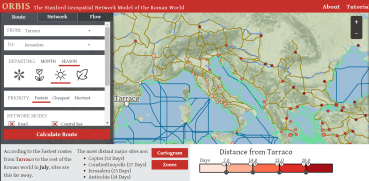
The interactivity also enables a greater fusion of humanities disciplines than was previously possible leading to new ways of blending and presenting information (Jones, 2014). Hyper-links and interactive digital interfaces allow different data types, sources and locations to be integrated in a way that feels natural and smooth. A good example of this blend is The Map of Early London, MoEML for short. MoEML blends history, cartography, linguistics and anthropology using a digital medium.

We have several layers to the MoEML map. First things first, it is a full website and to look at the MoEML project as a whole, we would be doing it an injustice if we were to only discuss the map. The MoEML website is also a database of historical texts and documents. It also has its own resources about organisations that existed at the time as well has historic figures that are relevant to documents connected to the AGAS map. This list of historical figures is hyperlinked to all connected texts that mention them throughout the website. That is a trend through the texts that can be found on MoEML, constant hyperlinking to relevant content between places, people and historical documents.
The use of this hyperlinking combines the cartographic elements of anthropology. This map is anthropological because through it, you can infer information about people and how they interacted in the past (RAI, 2018). Anthropology is really comes into play with record of neighbourhoods and locations made more clear with the historical documents linked to the locations that goes beyond record documents but also includes poems and more contemporary literature. This all gives us an insight into the culture of the time, we can see it in the language, the types of venues and places and even the layout of the city and its districts. The orgography section about the organisations that existed also falls under the banner of anthropology as it tells a little of the way industry and unionisation was occurring in London at the time.
Linguistics is another humanities discipline evident in MoEML through its utilisation of historic documents and literature that mention locations found on the AGAS map.
From the connected literature comes a source of linguistic history. If we take a look at the language used in the “Eastward Ho!” document that is linked to Christ Church location on the AGAS map.

Now, english is my primary, first and only language and yet there is so much linguistics in there that I can’t even begin to understand anything that it says. On a more serious note, looking at these historical documents gives us insight into how the use of the english language has evolved and in a lot of the more creative forms of literature, like in this play (Horwich, 1971) lose effect and meaning if they are converted in to more modern language.
I do like how the different regions and map sections are all linked to historic documents and literature containing their mention such as this poem connected to the area of Shoreditch.
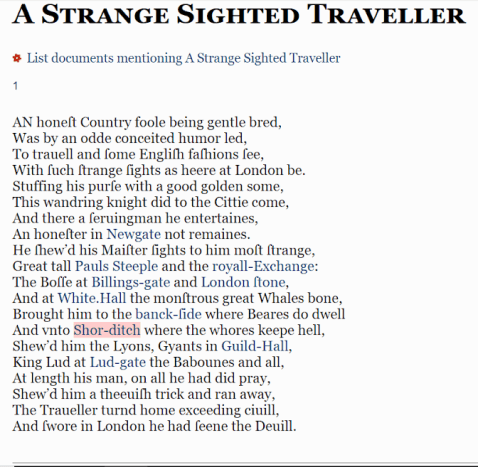
That being said the thing I dislike the most about MoEML is this very same feature. It is great having these literary references and in the case of poems and plays it really adds to the flavour of the map but it does not replace the need for a detailed explanation as to what the place actually is. Once again in the case of Shoreditch, The map displays it location and that it is a neighbourhood, but what about the wealth of the area? What kind of people lived there? When was it established? Any significant events that occurred there? None of these questions can be answered by the poem, which is one of the few pieces of historic text on the website that I can really make sense of. Potentially there could be sources of that information in the text list but I would have to go through each one to find them as the connected texts aren’t categorised by type or information that can be found within. This makes the AGAS digital map a good source to explore but maybe not the easiest way to find specific information about Elizabethan London. There are examples on the map that does have this extra detail but after researching available information I do not believe this is because a lack of information and not even the Tower of London has a simple description.
Now that projects like MoEML can be more accessible, I believe puts an onus upon developers of these resources to make their information accessible to this wider audience. MoEML even makes reference to being for a student audience and yet having the sources in this almost cryptic form makes in unapproachable for anyone without some prior or additional research.
Bibliography
Horwich, R. (1971). Hamlet and Eastward Ho. Studies in English Literature, 1500-1900, 11(2), 223-233. doi:10.2307/450061
Jones, S. (2014). The Emergence of the Digital Humanities (1st ed., p. 6). New York: Routledge.
Royal Anthropological Institute. (2018). What is Anthropology?. Retrieved 22 March 2018, from https://www.discoveranthropology.org.uk/about-anthropology/what-is-anthropology.html
Scheidel, W., & Meeks, E. (2018). ORBIS: The Stanford Geospatial Network Model of the Roman World. Orbis.stanford.edu. Retrieved 22 March 2018, from http://orbis.stanford.edu/
Thomas Wells Brignall III & Thomas Van Valey (2007). THE IMPACT OF INTERNET COMMUNICATIONS ON SOCIAL INTERACTION, Sociological Spectrum, 25:3, 335-348, DOI: 10.1080/02732170590925882

 The Nuclear Alternative