

Everywhere is a location or place; but is everywhere a locale?
This is the question I found imposed upon myself and my classmates, a question probably more fitting to a linguistics student rather than us media folk.
Anyhow,
There are two core takes on what a defines a locale in opposition to a regular old location. To best assess if a place is a locale we need to, if we accept that all locales are also locations, compare the definitions of locale to that of location and identify the semantics that make the two words differ. Those differences will be what makes a place a locale, anything that is common between the words is not significant as they are assumed to be common to all locations.
To begin we must note the definition of a location which is;
–‘A particular place or position’
A simple statement with no conditions beyond it being specific rather than vague owing to the word ‘particular’ being featured. From this whether or not a places is specific or not isn’t a defining characteristic of a locale based upon our earlier logic.
The first definition of locale comes from the most reputable of sources; Wikipedia
–‘Locale is the geographic place at which there is or was human activity. Locale indicates locations of present more dispersed, periodic or temporary human activity, such as a crossroad, a camp, a farm, a landing, a railroad siding, a ranch, a windmill or one of any of the various types of agricultural, communication, infrastructure or transport stations where human activities are carried out. Locale also indicates locations of former locales and incidents of human activity, such as a battlefield or historic site, former locations of populated places such as a ghost town or ruins or an archaeological site. https://en.wikipedia.org/wiki/Locale_(geographic)
This first definition is very much about human activity in a real physical sense. The human presence that features so heavily in this definition is also absent from the definition of location so it is a feature of out criteria. The definition also implies that locale refers to a more a place that does not have constant activity, more of a place visited or passed through.
The second definition of Locale comes from the ‘International Encyclopedia of Human Geography’, an altogether more academic source than Wikipedia
‘A spatial context or setting for action comprised of material elements as well as of sets of social norms and culturally shared values, to be understood as a material, socioeconomic, and sociocultural constellation of action with inter-subjective shared meaning contents. Therefore, it is an action-related concept that cannot be turned into an objective fact or generalized as a social category, having the same meaning for members of a society (in a certain region). ‘ (Werlen, 2009)
This definition, whilst still having a focus on a human element, is far less about physical occupation and use of space. It is all about the culture and vibe that a space conjures and sustains. A social context that is more or less unique. It does however acknowledge that a locale is not something that is objectively defined in its entirety, the style and nature of its existence being itself defined by those who use the space.
The resulting basic criteria that we are therefore looking at are;
-A location visited and passed through by people either presently or historically
-A location that has a unique social context wherein which the people who exist in the space determine and inform its culture
Based on those two assessments, the location that I nominate as being a prime and accurate example of a locale based upon both definition is the Student Union Recreational Library or S.U.R.L.Y. (No, I do not know where the Y in the acronym comes from either).
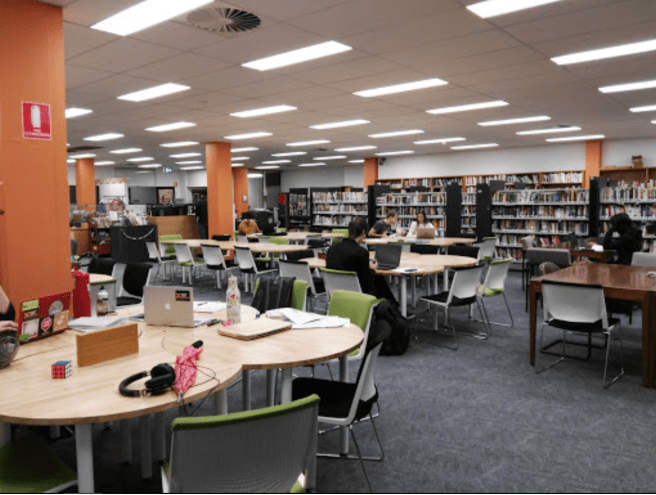
SURLY is located in the campus centre of the Monash University Clayton Campus and fills a unique role in university culture. Though it is a library it is unlike any others across the Monash Campuses. It doe have books, but they are predominantly fiction, it does have chairs to study in, but many of those are beanbags. It also has a Wii with super smash bros. which is a pretty unique thing to find in any academic institution. The S.U.R.L.Y is very much a recreational space, but a recreational space that maintains academic elements. Students do meet there and study, but it is a more relaxed and noisy form of study, it is social. In the rigorous academic culture that exists within university it is growing all the more important to have places of respite where students can unwind a little.
This all means that it is a unique social context. Where else can you go, across all Monash campuses, to engage in relaxed study or to just talk? Certainly not the Caulfield Library which, though it doesn’t have a rule enforcing silence, has generated an oppressive culture where the slightest whisper will result in getting shushed by a jumped up design student who thinks that their opinion and degree is valid, I digress.
The point I am trying to make is that the student culture that exists in SURLY is so important for the role that only this location provides. This all makes the space significant to students who use it, but don’t take my word for it. Here are some recording from actual students that use the library regularly talking about why it is significant to them.
Angelina
Daina
Ellie
Ray
Steve
The recording from ‘Ray’ gives a very direct reasons that the SURLY is important to him that fits very clearly with that first definition. He refers to the library as a place that he visits and that other people visit that he specifically enjoys for the background activity that occurs there.
The ideas raised that I find far more interesting is that of personal connections, not to the library itself but to other people in it. The other student’s from the recordings talk about the SURLY as a place that they go to socialise and meet with people. ‘Ellie’ places a specific emphasis upon the unique quality of the friends that she has made there. This qualifies it as unique social context, matching the second definition. More importantly it is an emotional point filled with feelings. It is the tying of feelings and emotion to place that gives it a clear vibe, consolidating it as special. For the friends that meet in this library, SURLY is tied to anecdotes and stories that will be retold into the future cementing its importance the university experience of these students.
I know the people who recorded these elements of audio for me and from that I know that many of them would not have met if it wasn’t for the Student Union Recreational Library. Its served as almost a recruiting ground for the group, whenever one of them meets a person that they like the are invited back to the library and are slowly indoctrinated into said group.
Significance is the thing that I feel, though not part of the definition, important to the vibe of the question. Why differentiate between a location and a locale except to a express an area as special or more significant compared to its surroundings?
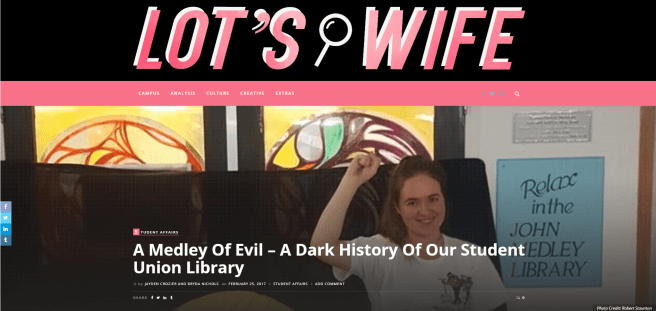
The SURLY library is also a part of ongoing history and change due to its focus as a point of student social activism. The SURLY used to be known, until this year, as the John Medely Library or JML. It was exposed however that John Medely, the man who gave his name to the library was a pretty significant eugenicist, not the best kind of person to immortalise the name of. The change came about specifically as the result of student activism through a campaign lead by the Lot’s Wife student newspaper. This gives the library a historical element that was mentioned in both definitions.
There is a further connection that the Student Union Recreational Library has to student history at Monash University. The library contains the physical records of editions of the student newspaper ‘Lot’s Wife’ with the records going back to the broadsheets initially published in the late 1960’s. These past editions give a unique glimpse into what student culture was like in the past outside of academia. It even shows the sense of humour that Lot’s Wife seems to have lost now showcased in articles like ‘How To Take LSD and Drop Out The Right Way’. It also shows focuses of student political activism and reveals that the university has had a strong left leaning influence since the 1960’s. These physical records are the most complete records of the Lot’s Wife student publication making SURLY an important space in its role as a repository for these publications.
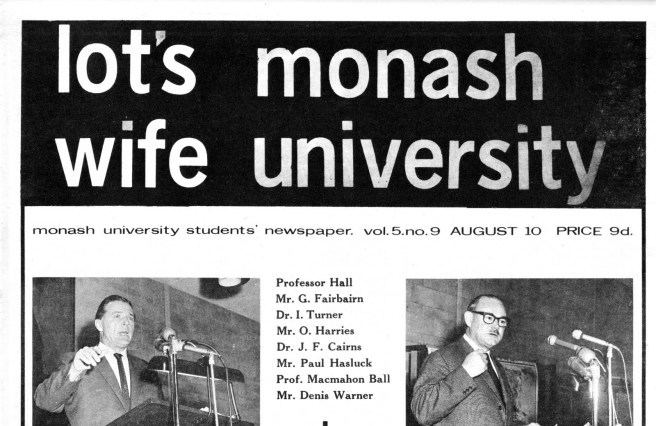
The Student Union Recreational Library has a special significance to me that is connected to those Lot’s Wife records. As bizarre of an idea as it seems, I went on a first date to the library to read through back issues from the sixties. This may not seem like the most romantic of contexts but it was a way to get to know a new person in my life and laugh together as we searched through the newspapers for interesting and amusing articles. It was a when I first really started to fall for this fun and amazing person who would think of something like this as a date activity. More than a year on and I am still happily in a relationship with this person and the Student Union Recreational Library will always be a part of our history together which I think is as significant as something can be.
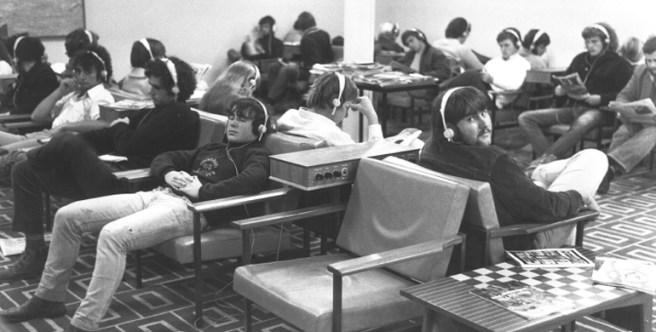
The discussion about whether a location is a locale or not has definitions but those definitions admit that there is an element that cannot be clearly defined. Despite the reasons made supporting SURLY as a locale based on the definitions I think that most important part aspect is about significance. Its about whether or not a place is significant enough to be a locale in some way, not just whether it meets technicalities regarding physical use of space. The personal elements are what first come to mind when I think about its significance as a place. The importance that this library has to students as a place to meet and create relationships that are special to them, friendship or romantic, is what I believe makes it more than just a location.
The Student Union Recreational Library is a Locale
References
About the Library – Monash. (2018). Retrieved from https://msa.monash.edu/services/msa-library/about-the-library/
Crozier, J., & Nichols, B. (2017). A Medley of Evil – A Dark History of Our Student Union Library. Retrieved from http://lotswife.com.au/a-medley-of-evil-a-dark-history-of-our-student-union-library/
Werlen, B. 2009. Regionalisations, Everyday. In Rob Kitchin & Nigel Thrift (eds.), International Encyclopedia of Human Geography, 286–293. Oxford: Elsevier. doi:10.1016/B978-008044910-4.00670-2. (electronic resource)
Locale (geographic). (2018). Retrieved from https://en.wikipedia.org/wiki/Locale_(geographic)

 The Nuclear Alternative