
To what extent do games deserve credit for the fun we have?
This is a question more complicated than you would initially expect. “Surely!”, you shout “if playing a game brings me enjoyment then it was fun”. I disagree, I strongly disagree, I powerfully rebel against that idea and cry unto the heavens “IT IS NOT SO!”. In my mind it all comes down which elements you enjoy and the extent to which the game facilitates that.
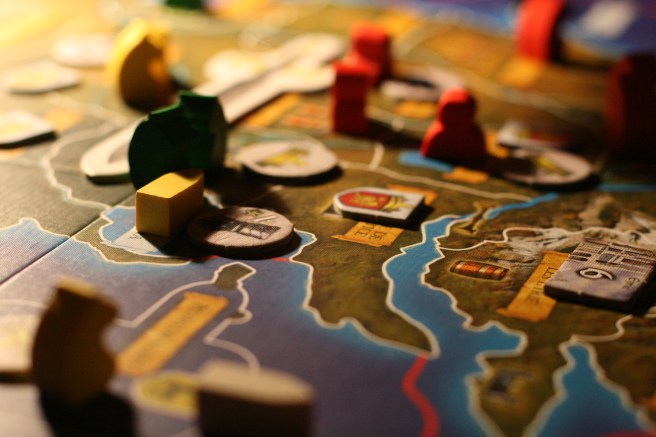
I want to preface this point I’m about to make and say that I am predominantly discussing table-top role playing games (RPGs) so my logic may not carry over to other genres. Table-top games are inherently a social experience, we are all actors in play as we tell a story together. Surely we are, as players, partially responsible for the fun that is had and conversely any lack of fun we may experience? Anyone who has played a table-top RPG or board game with someone who is selfish, rude or just uncooperative can tell you that a bad player diminishes our enjoyment. Someone who is funny and charismatic can also increase the fun we have in social contexts, by the same logic we must also give those people credit when they enrich our play experience.

The rule systems in games do however promote a specific kind of experience. Through codified mechanisms, games are able to evoke themes which tailor the player experience and allow us to select games based upon what we currently think would be ‘fun’ (to read more about evocation of themes check out my post here). The way games are written does have a great deal of impact on whether the play experience is ‘fun’ but I would argue that the attitudes and skills the players bring to the table are not second to rules. Players and mechanisms both have a similar stake in the overall positivity of the experience, neither being of greater importance than the other. The same burden of making the experience ‘fun’ is placed upon both elements.
There is a point however when the game itself deserves no credit for the experience of ‘fun’. I’ll set a scene here as an example; imagine you are playing a game with some of your good friends, you’ve been playing for a couple of hours now but no dice have been rolled since you are all just having a blast role-playing and conversing in character. In that situation the rules and mechanisms of the game are not being employed, you have ceased to play the game. You could take the game system from that story entirely without impacting it. In that instance only the players are generating ‘fun’ and the game is shouldering none of that burden.

This all seems pretty simple and logical yet it gets complicated when alternate rules are used, not just the ones written in the game book. Wizards of the Coast’s Dungeons & Dragons (D&D) is an example of a game that is serially hacked and altered by house rules. If at any point, the joy of play is being sourced from alternate rules I would argue that the game system cannot be given credit for it. D&D has an example of this that makes the burden of fun difficult to determine. In the Dungeon Master’s Guide for the 5th edition of D&D there is an alternate rule system for levelling up that replaces conventional experience points from killing monsters for ‘milestone experience’. This alternate take on the rules fundamentally changes the way character growth unfolds and the reward structure of D&D. I agree that rewarding more abstract activities than monster killing is a positive twist on D&D but even though it can be found in a supplementary rule book I would say that any enjoyment brought from that mechanism should not be attributed to the game system.

Milestone experience is not only a drastic departure from conventional D&D but it is also barely codified, the burden of making the rule work falls almost entirely upon the players themselves. The rules for milestones gives some examples of what a small or big milestone may be and how that could be quantified but its far from concrete and without general relevance. Without general relevance the examples given are not comparable to instances emergent from actual play. The flexibility to tell almost any story makes this general relevance almost impossible especially if the rule is only an amendment from a supplementary text rather than a core system to the game.
Playing games can be heaps of fun but but its important to know when to give the credit to the system or to pat yourself on the back for the good job you did instead.
Anyway as always, those are my thoughts. If you disagree or find fault with any claims I made feel free to leave a comment and further my understanding.

 The Nuclear Alternative
One thought on “Ceasing Play and the Burden of Fun”