
Recently I have been mulling over the definition of what constitutes a ‘game’. It isn’t as clear cut as a dictionary definition and I feel that different people have different criteria. A core element to what we consider as ‘games’ is a reward structure, a way to quantify our progress that structures the style of play. Until a few weeks ago whether or not there is a defined reward system present was how I differentiated games from interactive stories/narrative exercises.
 This schism in my opinions on game theory game about in playing Ben Robbins’ tabletop role-playing game ‘Kingdom‘. First and foremost ‘Kingdom’ is an incredibly well designed game and I recommend everyone with interest in tabletop RPGs give it a try. It is a game master-less system where players have equitable authority in deciding the fate of a metaphorical kingdom. This GM-less aspect is one of the two reasons facets to the issue of authority that this game has raised for me.

When we sit down and play a game of any sort, there is an imbalance of authority either between players and/or between the players and the rule systems. Whenever we play basketball or soccer etc. the team with the most points at the end of the game wins and this is undisputed because we look to the authority of the rules and what they dictate. When we play a computer game the programming of the game has authority in how it dictates what we can and cannot do. Similarly in chess we only move our bishops diagonally as we secede to the authority of the rules. Abiding by rules is how a system has authority and this is something that we are used to. Authority is the concept that is at the crux of what games are all about. It does not only define the parameters of play but I posit that it also gives meaning to ‘reward’.
I mentioned before that reward systems are a central concepts to what games are, I do not dispute this. Rewards however they come are only meaningful due to the struggle to fulfil the conditions in which we received them, without scarcity and challenge it is not rewarding. When we play games we can only be meaningfully rewarded by a greater authority. Without an imbalance of power reward is not scarce, if control was equal we could assign ourselves points at will. There is no struggle, no scarcity and thus no reward without an imbalance of authority.
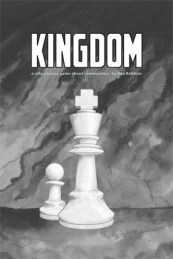 It is against this framework that ‘Kingdom’ really challenges my thinking. ‘Kingdom’ is a game where all players are on equal footing and also a game where the rules do not demand authority. It also has no real win/lose condition, we play to tell the story of the kingdom. I’ve been referring to ‘Kingdom’ as a ‘game’ but when compared to my own criteria it does not qualify due to the lack of authoritative dissonance.
Not meeting my criteria is something I find interesting rather than frustrating. Is there a wider category that games fall under that is still seperate from just entertainment? Is intent still valuable under what constitutes a game?
I think so.
The term that keeps coming to mind is ‘ludic system’ which I don’t believe is perfect as is as its still game centric yet its the best I have. I think that maybe all games are ludic systems but not all ludic systems are ‘games’ due to lacking the aforementioned authority imbalance. This comes about as I definitely consider systems such as ‘Kingdom’ as more game like than just a story exercise and that necessitates a separate yet relevant categorisation.
If you have a better label for this category or a dissenting opinion you’d like me to discuss leave a comment and I will get back to you.
 The Nuclear Alternative