The internet has altered the way time operates in how we communicate.
…both fictional and non-fictional texts have an ‘overall chronological sequence
Its a medium where people can connect and share, transcending the typical boundaries of space and time. ‘How can it transcend time?’ I hear you asking, it sounds like science fiction. However with the sharing power of the internet it is no more complicated than a ‘jump to the left’ or ‘step to the right’.
This written piece has its own inbuilt private chronology. It reads from start to finish and from top to bottom. It does not, however, have a place in conventional natural time that us mortals dwell within. This content is accessible at all times from almost anywhere, it does not have a cyclical nature of life to death or day to night. As pointed out by Angela Ehmer at Literacysolutions.com, the contents of both fictional and non-fictional texts have an ‘overall chronological sequence’.
The invention of hypertext-style narrative, even going back to hardcover ‘choose your own adventure’ style novels (Alexander. 18), further subverts conventional ideas of chronology. This has only been built upon by the development of the internet and especially with the technology to embed video content.
The SBS interactive documentary on the Goa Hippy Tribe though not a purely hypertext document utilises a hyper-textual structure as users negotiate through various connected pages to learn the story of the Goa Hippy Tribe. The documentary begins with a memorable quote from one of the Goa Hippies Tobias Moss “I really believe that everyone should take LSD at one point in their lives. It should be mandatory”. This quote opens the linear beginning of this documentary and serves to set the tone for what is discussed further. The website features a kind of virtual passport that is connected to your Facebook account as you login which allows the user to interact with past and future users of the site through comments left on different pages.
…through different hyperlinked web pages we get to choose the order in which we engage with content.
From that point forwards there is no defined path, through different hyperlinked web pages we get to choose the order in which we engage with content.
This gives hypertext-driven interactive platforms a meandering structure. It allows the user to explore content and engage, it is inherently democratising in its freedom of choice. We get to decide the order in which we interact with the content giving us co-authorship of our experience. Espen Aarseth aptly referred to these narratives as ‘ergodic literature’ where the term ergodic is derived from the Greek words for ‘work’ and ‘path’.
Ergodic literature, in its subversion of chronology, loses elements of conventional narrative structure. As an overall project of connected ideas it does not always have a coherency but it does maintain more conventional chronology in its sub-elements. The order you consume and observe different elements of the project may not have an order but those elements themselves do. As I mentioned before, text has its own convention of non-natural time and the embedded video interviews featured in Goa Hippy Tribe similarly have there own chronology.
The interviews, as examples of embedded video, show a small parcels of ‘now’ that present the same experience for all audiences. As stated by Lenart-Cheng in the journal article Concepts of Simultaneity and Community in the Crowd-Sourced Video Diary ‘Life in a Day,‘ “Video promises a unique way to capture the moment as it unfolds”. The ordered temporal nature of the videos that captures moments so purely, though antithetical to the more disparate overall hyper-textual structure, ensures that there is still that coherency within the documentary.
The progress of accessibility and video formatting has allowed not only a growth in interactivity but has granted us the ability to dictate the chronology with which we engage with media. The value of choice brought about through ergodic literature has been democratising without a loss of coherence due to the order brought by video elements.
Social media has given us a powerful platform in which to voice our opinions, so why is there a trend towards apathy?
The internet is a pretty bizarre space that has lent itself to the development of specific and niche cultures. Underlying the wide, near infinite variety found on the web there is however a common sentiment. Like more traditional cultures and communities, those that exist online have, to a degree, shared values among the vast majority of their populace. Its the values that we have in common that promote a sense of that which is to belong. The cultural value that seems to permeate the overall online community is that of apathy.
I hate to bring memes into this as I prefer to avoid cliche, but meme culture on Facebook is a very defined example of this apathy at play.
Memes are most commonly a form of dark humour making light of tragedy or embracing a lack of meaning through the excessively abstract. The humour and sometime meaningless subject matter of memes is however expressive on an apathetic sentiment summed up best in reference to the post WWII era art form of dadaism (Hoins).
Neo-dadaism stems from the dadaist art movement that arose at the end of WWII and the beginning of the cold war (Guggenheim). It embraces similar ideals to that of absurdist theatre, to demonstrate the pointlessness of human existentialism. Increasingly abstract and nonsensical art to promote the sentiment that nothing matters, a statement against statements. In its original context this was a cultural response to the looming threat of nuclear annihilation and post-war disenfranchisement, but today similar sentiments have arisen through increasing techno-isolation and political dis-empowerment (Ruiz).
“identities are not hermetically sealed”
As humans our identities are not hermetically sealed, modern identity construction is “accelerated, fluid, and dislocating as has been virtually all aspects of our current economic and social experience within our societies” (Lambert & Hestler 12). The media we consume and the methods through which we communicate are elements that affect this growth. As we witness, share and identify with apathetic content, our engagement further promotes it within both ourselves and others. We use memes as tools to communicate and since memes are almost exclusively apathetic in nature our messages take on that tone. This is because very few people are content creators, the 90:9:1 states that only around 1% of internet users create and share content (Nielson). A vast majority merely consume and share and thus it is the attitudes of the creators that are purported over others in a form of inferred censorship.
We communicate now more by reusing or showing public approval for existing content rather than making a personal statement, it is more passive yet can be equally expressive, though it it comes at the aforementioned cost of conformity to ideals of content creators. The all pervasiveness of this ubiquitous connection style consumer culture can leave us feeling “alienated and indifferent” (Delwiche et al 7).
Meme culture has reduced the specificity of how those who engage with it communicate on a wider platform. This removes a degree of authenticity unless there is conformity to the message of the created content. In this context the trend of identifying with memes becomes problematic. The ‘it me’ response to ‘relatable’ memes is an example of that sense of conformity, very few representations that have wide applicability are also specific enough to embody the genuine feelings of any individual, yet we still see the ‘it me’ sentiment reflected on mass. This implies a mass conformity to an ideal and, as we perpetuate that sentiment it will only become more true as we further influence those around us through an echo chamber of digital consumption (Emba).
Overall memes are a fascinating method of communication that infer much through context alone. The humour that comes from the abstract and ‘cookie-cutter’ type format does however limit what they can convey to a predominately apathetic tone.
To what extent do games deserve credit for the fun we have?
This is a question more complicated than you would initially expect. “Surely!”, you shout “if playing a game brings me enjoyment then it was fun”. I disagree, I strongly disagree, I powerfully rebel against that idea and cry unto the heavens “IT IS NOT SO!”. In my mind it all comes down which elements you enjoy and the extent to which the game facilitates that.
“To what extent do games deserve credit for the fun we have?”
I want to preface this point I’m about to make and say that I am predominantly discussing table-top role playing games (RPGs) so my logic may not carry over to other genres. Table-top games are inherently a social experience, we are all actors in play as we tell a story together. Surely we are, as players, partially responsible for the fun that is had and conversely any lack of fun we may experience? Anyone who has played a table-top RPG or board game with someone who is selfish, rude or just uncooperative can tell you that a bad player diminishes our enjoyment. Someone who is funny and charismatic can also increase the fun we have in social contexts, by the same logic we must also give those people credit when they enrich our play experience.
“The way games are written does have a great deal of impact on whether the play experience is ‘fun'”
The rule systems in games do however promote a specific kind of experience. Through codified mechanisms, games are able to evoke themes which tailor the player experience and allow us to select games based upon what we currently think would be ‘fun’ (to read more about evocation of themes check out my post here). The way games are written does have a great deal of impact on whether the play experience is ‘fun’ but I would argue that the attitudes and skills the players bring to the table are not second to rules. Players and mechanisms both have a similar stake in the overall positivity of the experience, neither being of greater importance than the other. The same burden of making the experience ‘fun’ is placed upon both elements.
There is a point however when the game itself deserves no credit for the experience of ‘fun’. I’ll set a scene here as an example; imagine you are playing a game with some of your good friends, you’ve been playing for a couple of hours now but no dice have been rolled since you are all just having a blast role-playing and conversing in character. In that situation the rules and mechanisms of the game are not being employed, you have ceased to play the game. You could take the game system from that story entirely without impacting it. In that instance only the players are generating ‘fun’ and the game is shouldering none of that burden.
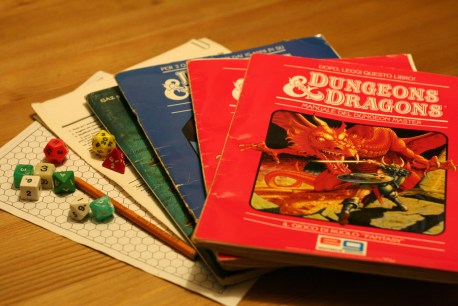
The Dungeon Master’s Guide is a supplementary text for the game of D&D
This all seems pretty simple and logical yet it gets complicated when alternate rules are used, not just the ones written in the game book. Wizards of the Coast’s Dungeons & Dragons(D&D) is an example of a game that is serially hacked and altered by house rules. If at any point, the joy of play is being sourced from alternate rules I would argue that the game system cannot be given credit for it. D&D has an example of this that makes the burden of fun difficult to determine. In the Dungeon Master’s Guide for the 5th edition of D&D there is an alternate rule system for levelling up that replaces conventional experience points from killing monsters for ‘milestone experience’. This alternate take on the rules fundamentally changes the way character growth unfolds and the reward structure of D&D. I agree that rewarding more abstract activities than monster killing is a positive twist on D&D but even though it can be found in a supplementary rule book I would say that any enjoyment brought from that mechanism should not be attributed to the game system.
“Milestone experience is not only a drastic departure from conventional D&D but it is also barely codified”
Milestone experience is not only a drastic departure from conventional D&D but it is also barely codified, the burden of making the rule work falls almost entirely upon the players themselves. The rules for milestones gives some examples of what a small or big milestone may be and how that could be quantified but its far from concrete and without general relevance. Without general relevance the examples given are not comparable to instances emergent from actual play. The flexibility to tell almost any story makes this general relevance almost impossible especially if the rule is only an amendment from a supplementary text rather than a core system to the game.
Playing games can be heaps of fun but but its important to know when to give the credit to the system or to pat yourself on the back for the good job you did instead.
Anyway as always, those are my thoughts. If you disagree or find fault with any claims I made feel free to leave a comment and further my understanding.
Last night while knee-deep in procrastination I stumbled across the music video of Unknown Mortal Orchestra’s ‘Hunnybee’.
It’s not the type of music that I normally listen to but the art style and visuals present in the video got me thinking about how often we see trains as a setting in literature and media.
Trains represent a unique bubble within which a story can progress dynamically without being distracted by changes in scene. In the above clip, we see a peaceful vista of nature that the train travels through, carrying the silent focus and her luggage through this terrain. This scenery, however, is almost exclusively witnessed from the train itself, a consistent setting that until the very end, contains the story. Even when the camera briefly departs from the train itself, it is only establishing context to give us a sense of its movement. The story never ceases to have is core focus upon the subject of the cabin.
“[the worm eaten branch] creates tension surrounding contents of the train”When the scene shifts to the worm-eaten branch it creates tension surrounding contents of the train, not a focus in and of its self. Like the tipping of the luggage, this promise of action and change is one targeting the subject within the train. The falling of the branch provides the tension through the threat of derailment.
Though not touched on in the video of ‘Hunnybee’, trains have become a vital tool in story-telling to contain a narrative and drive tension without exacerbating feelings of claustrophobia.
‘Who’s Afraid of Virginia Woolf’ is a play set entirely in a single room
While the train is in locomotion, the setting is kept static. Characters are unable to embark or leave, focusing the narrative on their interactions. Unlike works of fiction contained to one space (such as ‘Who’s Afraid of Virginia Woolf’) the audience is left a release from the claustrophobia as the train moves and the vista changes. We are given an illusion of movement even though, like the characters, we never leave the space of the carriages. This space is still functionally identical to a single room.
The use of the train as a narrative device to place character interaction in the forefront is expertly wielded by Agatha Christie in her famous novel ‘Murder on the Orient Express’. In this book, the set up of the characters and plot is interspersed with travel and stops at various locations surrounding the train. However, the action and the core mystery takes place completely within the train itself.
“[tension is] somewhat lost in the most recent cinematic adaption directed by Kenneth Branagh”Christie plays with the concept of isolation by having the train stalled, trapped by an avalanche. This shatters the illusion of freedom provided by a moving locomotive, emphasising the tension through that contrast. This is somewhat lost in the most recent cinematic adaption (directed by Kenneth Branagh) as high tension scenes, previously contained within the carriages, take place upon the snowy mountainside where the train is stalled.
Other methods of transport can still be utilised to demonstrate these story elements but I would argue that trains are the most effective. It is true that you can have chance meetings in a taxi, aeroplane or, (as shown at the end of the movie ‘Sliding doors’) an elevator. I would argue however that trains are special case from how they are historically presented in literature and from their accessibility.
“Everyone on a train has to put up with the same transit experience”
Trains have often been presented as a location that readily breeds interactivity. It is more of a united, shared space. Everyone on a train has to put up with the same transit experience, other vehicles do not carry the same connotations. Each train carriage is its own contained community, a community with very little resources beyond its characters. No other transit method so readily provides the potential of community or character-driven drama.
Trains are unique in what they provide as a literary tool and are the ultimate example of transit in storytelling. It provides a consistent setting that is closed, yet feels open, allowing us to experience tension without being made uncomfortable.
I hope this has been somewhat interesting and isn’t just a self-indulgent expression of some bizarre, pseudo-intellectual train fetish that I’ve unconsciously developed. Drop a comment and let me know what you think about trains in stories or to let me know about a topic you find interesting that I could try exploring.
This is a question that I consider to be central to the concept of table-top role-playing games (RPGs). They are an interactive narrative experience where the fun comes from their interactivity and the ‘freedom’ of playing make believe. Freedom is however, unfulfilling when it is devoid of structure. Without rules and restrictions there is no challenge, no focus and no direction.
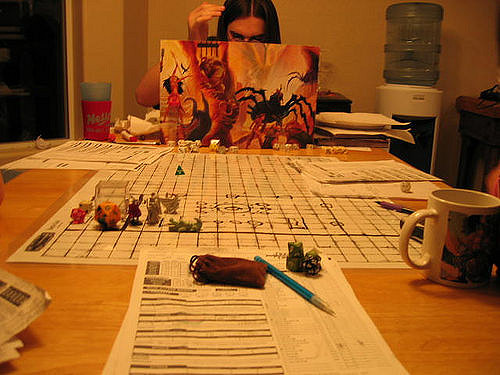
A table-top rpg in action
I believe that, in the context of RPGs, we enjoy wrangling our freedom from a system and engaging with the rules much more than just being given total narrative freedom. If that is what we preferred the hobby would dissolve and gamers would become novelists.
There is a point however, when rules become too much. Restrictions can impeded too greatly upon our agency within the ludo-narrative.
But ‘how far is too far?’ and ‘when do rules not go far enough?’
Rules and storytelling combine in tabletop role-playing games to, like the lions of Voltron, become something greater than the sum of its parts. This unity however, brings the concepts into competition. When poor design is employed, bringing these forces together brings out the worst of both worlds. Too many rules and we feel oppressed, too much freedom and we feel lost and without direction.
This brings us back to the term of ‘ludo-narrative’ that I used earlier. The ludo-narrative is the story that unfolds within the context of a game. More commonly this refers to video games but it still works in the context of RPGs. Building upon that, there is a concept in design called ‘ludo-narrative dissonance’. It is the symptom of having an incorrect balance of rules to story and reflects how the rules governing play contradict the unfolding narrative.
When those elements are correctly balanced however, that dissonance is avoided and you have a bittersweet game system that sits upon the mental palate in a way that is both evocative and refreshing.
“But Callum?!” you may ask “what does it mean for a game system to be evocative?” In response to this question I posit that all ‘good’ games use their rules to restrict themselves to one kind of defined experience.
Rule systems portray a “delicate balancing act”
Rule systems found in role-playing games truly fascinate me due to the delicate balancing act they inherently portray. Each different game has a different approach to marrying player agency with the restrictions that are required to define this experience.
I used a lot of flowering language in that paragraph so I’ll take some time to break down what I mean in my use of the phrase ‘define the experience’.
Each role-playing game worth its salt is written to evoke a target theme by facilitating certain styles of play. For a game to evoke this theme it must have that theme codified within its rules and reward systems. As a result of this, it should be impossible for the theme to be avoided when the game is played as written. The rules of the game must ‘define the experience’ of play. This is quite a bold claim but it is mirrored in games that are successful to at least some extent.
A good case study for a game that does this well is Luke Crane’s Burning Wheeland if you want to read the justification for my claim you can find my case study analysis here.
A more common example of a game that has this practice is Wizards of the Coast’s Dungeons & Dragons (D&D).
“[D&D is] an unavoidable behemoth that is more influential that it has any right to still be.”I hate talking about this game. No matter how much the hobby of RPGs and the game design surrounding them changes and grows, the influence of D&D cannot be shaken. It fills the same role in game design that is filled by Donald Trump in current political studies. An unavoidable behemoth that is more influential that it has any right to still be.
Keeping that in mind, I have to begrudgingly admit that despite its many faults, Dungeons & Dragons has a core defined experience in each of its iterations. The game D&D is about combat, killing things by lowering their health to zero. Every reward system in the game stems from this, you get experience points to level up which is the only codified kind of character growth in the game and also some sort of treasure is often left behind after a foe is slain. You cannot play D&D as it is written without having a great deal of combat (well you can but I’d argue that you aren’t playing D&D anymore; my thoughts on this can be found here). The rules restrict the game to that focus by having in depth systems for fighting which is untrue for almost everything else that isn’t combat.
This tunnel-vision approach to design is good because it supplies clear direction to the players, If they want to play a game were they fight things D&D is a good and clear choice.
What we have seen with the growth of the internet as a self-publishing tool is a boom in independent RPG systems that carve out their niches by having a unique theme that they evoke. Trying to make a system that does everything is not only impossible to do without losing quality but is also no longer up to date with the way the community uses games. Game systems are tools that are selected to match the type of story that the users want to tell. We are seeing more public examples of games changing systems as the style of narrative being told no longer fits the system in which it began. Real-play podcasts such as The Adventure Zone and Friends at the Table are recorded examples of this practice. Games are chosen based on the themes that they evoke through codified rules.
T
It is the purpose of rules in story telling, to evoke certain themes and style of play the provide direction to those involved.
Or at least that’s what I think. If you disagree or just have something to add leave a comment and I’ll get back to you.
Everywhere is a location or place; but is everywhere a locale?
This is the question I found imposed upon myself and my classmates, a question probably more fitting to a linguistics student rather than us media folk.
Anyhow,
There are two core takes on what a defines a locale in opposition to a regular old location. To best assess if a place is a locale we need to, if we accept that all locales are also locations, compare the definitions of locale to that of location and identify the semantics that make the two words differ. Those differences will be what makes a place a locale, anything that is common between the words is not significant as they are assumed to be common to all locations.
To begin we must note the definition of a location which is;
–‘A particular place or position’
A simple statement with no conditions beyond it being specific rather than vague owing to the word ‘particular’ being featured. From this whether or not a places is specific or not isn’t a defining characteristic of a locale based upon our earlier logic.
The first definition of locale comes from the most reputable of sources; Wikipedia
–‘Locale is the geographic place at which there is or was human activity. Locale indicates locations of present more dispersed, periodic or temporary human activity, such as a crossroad, a camp, a farm, a landing, a railroad siding, a ranch, a windmill or one of any of the various types of agricultural, communication, infrastructure or transport stations where human activities are carried out. Locale also indicates locations of former locales and incidents of human activity, such as a battlefield or historic site, former locations of populated places such as a ghost town or ruins or an archaeological site.https://en.wikipedia.org/wiki/Locale_(geographic)
This first definition is very much about human activity in a real physical sense. The human presence that features so heavily in this definition is also absent from the definition of location so it is a feature of out criteria. The definition also implies that locale refers to a more a place that does not have constant activity, more of a place visited or passed through.
The second definition of Locale comes from the ‘International Encyclopedia of Human Geography’, an altogether more academic source than Wikipedia
‘A spatial context or setting for action comprised of material elements as well as of sets of social norms and culturally shared values, to be understood as a material, socioeconomic, and sociocultural constellation of action with inter-subjective shared meaning contents. Therefore, it is an action-related concept that cannot be turned into an objective fact or generalized as a social category, having the same meaning for members of a society (in a certain region). ‘ (Werlen, 2009)
This definition, whilst still having a focus on a human element, is far less about physical occupation and use of space. It is all about the culture and vibe that a space conjures and sustains. A social context that is more or less unique. It does however acknowledge that a locale is not something that is objectively defined in its entirety, the style and nature of its existence being itself defined by those who use the space.
The resulting basic criteria that we are therefore looking at are;
-A location visited and passed through by people either presently or historically
-A location that has a unique social context wherein which the people who exist in the space determine and inform its culture
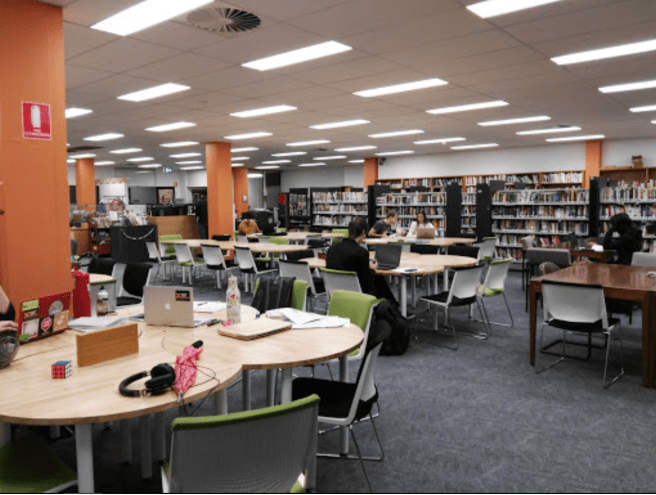
Based on those two assessments, the location that I nominate as being a prime and accurate example of a locale based upon both definition is the Student Union Recreational Library or S.U.R.L.Y. (No, I do not know where the Y in the acronym comes from either).
SURLY is located in the campus centre of the Monash University Clayton Campus and fills a unique role in university culture. Though it is a library it is unlike any others across the Monash Campuses. It doe have books, but they are predominantly fiction, it does have chairs to study in, but many of those are beanbags. It also has a Wii with super smash bros. which is a pretty unique thing to find in any academic institution. The S.U.R.L.Y is very much a recreational space, but a recreational space that maintains academic elements. Students do meet there and study, but it is a more relaxed and noisy form of study, it is social. In the rigorous academic culture that exists within university it is growing all the more important to have places of respite where students can unwind a little.
This all means that it is a unique social context. Where else can you go, across all Monash campuses, to engage in relaxed study or to just talk? Certainly not the Caulfield Library which, though it doesn’t have a rule enforcing silence, has generated an oppressive culture where the slightest whisper will result in getting shushed by a jumped up design student who thinks that their opinion and degree is valid, I digress.
The point I am trying to make is that the student culture that exists in SURLY is so important for the role that only this location provides. This all makes the space significant to students who use it, but don’t take my word for it. Here are some recording from actual students that use the library regularly talking about why it is significant to them.
Angelina
Daina
Ellie
Ray
Steve
The recording from ‘Ray’ gives a very direct reasons that the SURLY is important to him that fits very clearly with that first definition. He refers to the library as a place that he visits and that other people visit that he specifically enjoys for the background activity that occurs there.
The ideas raised that I find far more interesting is that of personal connections, not to the library itself but to other people in it. The other student’s from the recordings talk about the SURLY as a place that they go to socialise and meet with people. ‘Ellie’ places a specific emphasis upon the unique quality of the friends that she has made there. This qualifies it as unique social context, matching the second definition. More importantly it is an emotional point filled with feelings. It is the tying of feelings and emotion to place that gives it a clear vibe, consolidating it as special. For the friends that meet in this library, SURLY is tied to anecdotes and stories that will be retold into the future cementing its importance the university experience of these students.
I know the people who recorded these elements of audio for me and from that I know that many of them would not have met if it wasn’t for the Student Union Recreational Library. Its served as almost a recruiting ground for the group, whenever one of them meets a person that they like the are invited back to the library and are slowly indoctrinated into said group.
Significance is the thing that I feel, though not part of the definition, important to the vibe of the question. Why differentiate between a location and a locale except to a express an area as special or more significant compared to its surroundings?
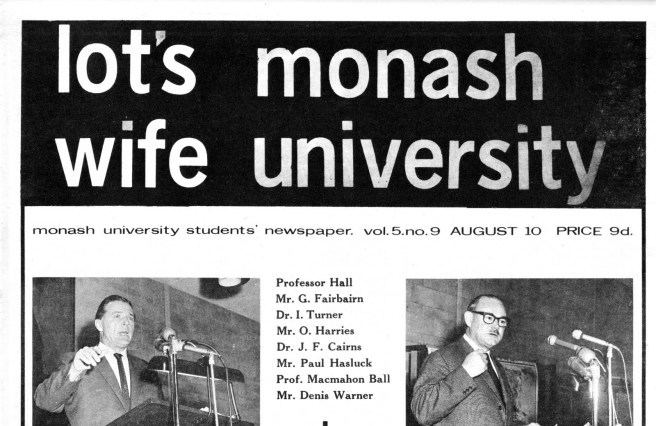
The SURLY library is also a part of ongoing history and change due to its focus as a point of student social activism. The SURLY used to be known, until this year, as the John Medely Library or JML. It was exposed however that John Medely, the man who gave his name to the library was a pretty significant eugenicist, not the best kind of person to immortalise the name of. The change came about specifically as the result of student activism through a campaign lead by the Lot’s Wife student newspaper. This gives the library a historical element that was mentioned in both definitions.
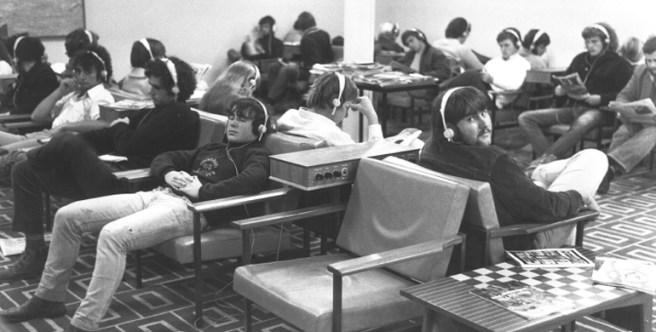
There is a further connection that the Student Union Recreational Library has to student history at Monash University. The library contains the physical records of editions of the student newspaper ‘Lot’s Wife’ with the records going back to the broadsheets initially published in the late 1960’s. These past editions give a unique glimpse into what student culture was like in the past outside of academia. It even shows the sense of humour that Lot’s Wife seems to have lost now showcased in articles like ‘How To Take LSD and Drop Out The Right Way’. It also shows focuses of student political activism and reveals that the university has had a strong left leaning influence since the 1960’s. These physical records are the most complete records of the Lot’s Wife student publication making SURLY an important space in its role as a repository for these publications.
The Student Union Recreational Library has a special significance to me that is connected to those Lot’s Wife records. As bizarre of an idea as it seems, I went on a first date to the library to read through back issues from the sixties. This may not seem like the most romantic of contexts but it was a way to get to know a new person in my life and laugh together as we searched through the newspapers for interesting and amusing articles. It was a when I first really started to fall for this fun and amazing person who would think of something like this as a date activity. More than a year on and I am still happily in a relationship with this person and the Student Union Recreational Library will always be a part of our history together which I think is as significant as something can be.
The discussion about whether a location is a locale or not has definitions but those definitions admit that there is an element that cannot be clearly defined. Despite the reasons made supporting SURLY as a locale based on the definitions I think that most important part aspect is about significance. Its about whether or not a place is significant enough to be a locale in some way, not just whether it meets technicalities regarding physical use of space. The personal elements are what first come to mind when I think about its significance as a place. The importance that this library has to students as a place to meet and create relationships that are special to them, friendship or romantic, is what I believe makes it more than just a location.
The Student Union Recreational Library is a Locale
Werlen, B. 2009. Regionalisations, Everyday. In Rob Kitchin & Nigel Thrift (eds.), International Encyclopedia of Human Geography, 286–293. Oxford: Elsevier. doi:10.1016/B978-008044910-4.00670-2. (electronic resource)
It goes without saying that the mass adoption of the internet and digital technologies has revolutionised the way we live and how we communicate (Brignall, 2007).
Instant communication has the power to bring us together like nothing else has over the course of human history, enabling us to interact from the comfort of our homes . This change has has huge implications for how we present data and the types of audience that our data can have.
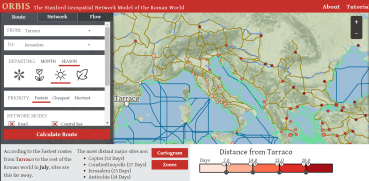
The ability to present information in an interactive manner has widened the audiences for humanities research by making it more accessible. The number of people willing to read a journal article on the modes of transport and travel times available during the Roman Empire is probably small and odds are made up purely of academics and historians, but lo and behold this same data has been presented to a wider audience in the for of Orbis.
The interactivity also enables a greater fusion of humanities disciplines than was previously possible leading to new ways of blending and presenting information (Jones, 2014). Hyper-links and interactive digital interfaces allow different data types, sources and locations to be integrated in a way that feels natural and smooth. A good example of this blend is The Map of Early London, MoEML for short. MoEML blends history, cartography, linguistics and anthropology using a digital medium.
We have several layers to the MoEML map. First things first, it is a full website and to look at the MoEML project as a whole, we would be doing it an injustice if we were to only discuss the map. The MoEML website is also a database of historical texts and documents. It also has its own resources about organisations that existed at the time as well has historic figures that are relevant to documents connected to the AGAS map. This list of historical figures is hyperlinked to all connected texts that mention them throughout the website. That is a trend through the texts that can be found on MoEML, constant hyperlinking to relevant content between places, people and historical documents.
The use of this hyperlinking combines the cartographic elements of anthropology. This map is anthropological because through it, you can infer information about people and how they interacted in the past (RAI, 2018). Anthropology is really comes into play with record of neighbourhoods and locations made more clear with the historical documents linked to the locations that goes beyond record documents but also includes poems and more contemporary literature. This all gives us an insight into the culture of the time, we can see it in the language, the types of venues and places and even the layout of the city and its districts. The orgography section about the organisations that existed also falls under the banner of anthropology as it tells a little of the way industry and unionisation was occurring in London at the time.
Linguistics is another humanities discipline evident in MoEML through its utilisation of historic documents and literature that mention locations found on the AGAS map.
From the connected literature comes a source of linguistic history. If we take a look at the language used in the “Eastward Ho!” document that is linked to Christ Church location on the AGAS map.
Now, english is my primary, first and only language and yet there is so much linguistics in there that I can’t even begin to understand anything that it says. On a more serious note, looking at these historical documents gives us insight into how the use of the english language has evolved and in a lot of the more creative forms of literature, like in this play (Horwich, 1971) lose effect and meaning if they are converted in to more modern language.
I do like how the different regions and map sections are all linked to historic documents and literature containing their mention such as this poem connected to the area of Shoreditch.
That being said the thing I dislike the most about MoEML is this very same feature. It is great having these literary references and in the case of poems and plays it really adds to the flavour of the map but it does not replace the need for a detailed explanation as to what the place actually is. Once again in the case of Shoreditch, The map displays it location and that it is a neighbourhood, but what about the wealth of the area? What kind of people lived there? When was it established? Any significant events that occurred there? None of these questions can be answered by the poem, which is one of the few pieces of historic text on the website that I can really make sense of. Potentially there could be sources of that information in the text list but I would have to go through each one to find them as the connected texts aren’t categorised by type or information that can be found within. This makes the AGAS digital map a good source to explore but maybe not the easiest way to find specific information about Elizabethan London. There are examples on the map that does have this extra detail but after researching available information I do not believe this is because a lack of information and not even the Tower of London has a simple description.
Now that projects like MoEML can be more accessible, I believe puts an onus upon developers of these resources to make their information accessible to this wider audience. MoEML even makes reference to being for a student audience and yet having the sources in this almost cryptic form makes in unapproachable for anyone without some prior or additional research.
Bibliography
Horwich, R. (1971). Hamlet and Eastward Ho. Studies in English Literature, 1500-1900,11(2), 223-233. doi:10.2307/450061
Jones, S. (2014). The Emergence of the Digital Humanities (1st ed., p. 6). New York: Routledge.
Scheidel, W., & Meeks, E. (2018). ORBIS: The Stanford Geospatial Network Model of the Roman World. Orbis.stanford.edu. Retrieved 22 March 2018, from http://orbis.stanford.edu/
Thomas Wells Brignall III & Thomas Van Valey (2007). THE IMPACT OF INTERNET COMMUNICATIONS ON SOCIAL INTERACTION, Sociological Spectrum, 25:3, 335-348, DOI: 10.1080/02732170590925882
A lot of the focus within launching a business, initiative or anything new, is the beginning.
The concept of starting your own project and taking that first step of action is almost romanticised as being meaningful and significant. In a way this romanticism is justified, it is a big milestone, but the real work lies in keeping your wonderful passion project afloat. There is nothing glamorous about hard work, stress and the late nights that follow that initial launch phase and the allure of newness starts to fade.
Those first steps of planning and beginning are so exciting because at that stage it is still just an idea. It is yet to come to true fruition and is devoid of all of the unforeseen problems that arise after implementation. Making a difference and taking action is difficult but most of that difficulty is an internal one about stress and anxiety and ultimately about you. Once things get into motion and that initial action has been successful the issues that arise become a lot more interpersonal.
People tend to resist change. It isn’t malicious, it is just that if things are comfortable change feels like it could threaten that comfort. This is an issue clearly recognised and approached when in that first phase of initiating the new idea or system but is just as big of a threat to success in attempting to sustaining any change that you may have enforced. Even after agreeing initially many individuals have an elastic-like tendency to try to snap back to their old ways. After that original push people will start to slowly start to push back as that initial enthusiasm fades. This second stage of resistance is often not anticipated and can be crippling.
The way to overcome this resistance is through momentum.
The nature of how hard you have to push and communicate and reinforce the goals of what you are trying to achieve does not change after launching a project. You need to keep reaching out to the people already on board just as much as you need to reach out to new people. Consolidation can often fall behind outreach and expansion but ultimately it is of equal importance. If you as a leader you back off your interactions with your initial connections and team you will start to lose them as it is likely that their enthusiasm will wane faster than your own.
If you continue to communicate with those already involved in your cause and continue to consolidate and push your agenda you can maintain that essential momentum and keep those around you motivated to sustain the change you have brought about.
Without taking action and placing our money where our mouth is we can’t bring about change. This change that we seek is inspired by our personal values and beliefs so why are we so tentative about make that leap from idea into action.
Taking action is so daunting because it is ultimately a commitment. It may not be the first or second step in an operation but there is always a tipping point, a step where the project gains momentum and begins to drive itself.
At that point deadlines become self-imposing. It becomes a matter of necessity to get things completed on a timeline rather than or arbitrary preference and convenience. This is the point that sparks all-nighters and the anxiety that is inherent to any deadline based task.
That commitment is intimidating. From that tipping point forwards you can no longer decide to close up and just walk away. It becomes a matter of not only logistics but also emotional investment. The logistical aspect of the issue is the time that it demands and the sheer volume of work that springs up unforeseen. All of this extra work is what inspires emotional investment. As much as you may think you care about an idea in theory that is nothing compared to how you feel after hours and hours of your time has been sunk into something. It becomes not only about the issue but about your own involvement in the project and how the progress reflects your capabilities. To see an idea fail, though not the end of the world can easily feel like it. After all that effort it becomes a matter of not pride but self-worth.
This tie to the concept of self-esteem and self-worth is what I believe holds a lot of us back, more so than the more physical organisational issues. The reason we entertain the idea of making changes or starting something with the intention of impact is because we feel that we have the ability to succeed. Failure is always an acknowledged possibility but its never the focus, that is why this emotional investment can be so degrading and intimidating. The looming potential of failure threatens that surety in our abilities, it threatens one of the key driving forces behind our ambition.
The first issue to overcome is never the problem itself but the dread of a potential error caused in the wake of attempts. This dread is arguably worse than an actual problem because it prevents us from taking that first step and with out that step being taken we cannot learn, grow or succeed.
Taking action and making that commitment to a project is ultimately a gamble no matter how organised an individual may be.
In every aspect of our lives we come up against setbacks, thing and events that ultimately wall us off from success.
These metaphorical barriers that block our paths forwards come in a multitude of forms from painful bureaucracy to more physical issues such as the weather or an inevitable and all too common train delay. Any obstacle to success can be viewed as a problem requiring a solution, it is very rare that something cannot be solved or at least mitigated. The big and critically introspective question you have to ask yourself knowing that there can almost always be a resolution whenever you do come up against a barrier is ‘am I allowing this problem to exist?’.
I observe predominantly in myself I admit that any small issue that slows down a predicted timeline or plan opens up an opportunity to become slack, blaming lack of progress on the external problem. Slackness in this instance should not be interpreted with its usual negative connotations but more of as symptom or result. When you are juggling deadlines and projects often something has to give or be delayed and a small slowdown in management creates the space for that delay to occur in a manner we can convince ourselves is unavoidable.
For me at least this is more of symptom of a different issue rather than its own contained thing. It all seems to be the result of poor prioritisation.
A study into the pursuit of scholarship in the medical profession published in the Medical Education Journal identified that aside from motivation the other two main factors that inhibited progress were to do with time, time fragmentation and prioritisation. Time fragmentation refers to only having sporadic opportunities to make progress on the task in question and prioritisation as you would expect refers to the the relative importance of different tasks that compete for your time. The conclusion of the study was that productivity is more complicated than just the number of hours available in a day but required structures within institution to support and encourage progress.
This becomes an issue in start-up initiatives even on the microscopic scale that I am involved in. There are no structures in place to support productivity. Such a small idea just doesn’t accommodate it.
With no structured heirachy of importance it falls to us to prioritise within our own workloads as time simply isn’t enough. Its all too easy to label everything as of equal importance but that just leads to an amount of tasks that feels insurmountable regardless of how simple they may each be individually. This inevitably leads to a build up of stress and a feeling of hopelessness which ultimately inhibits productivity.
At this point of stress is where we look for those barriers as excuses to cut out chunks of our tasks and brings us back to the intial step of no lrogress being made but it feels better this way as its ‘not our fault’.
Most of our barriers only exist because we allow them to and the only way to make progress is to critically restructure they way we think about our work.



















 The Nuclear Alternative